
(This is a conversation between Big Media Vandalism's resident troublemakers, Steven Boone and Odie "Odienator" Henderson. It is the third in a series of "Black Man Talks." The others may be found here and here.)

(WARNING!! Do not read this if you haven't seen the film! I will personally come of out of this screen and slap the shit out of you if you bitch about spoilers. Proceed at your own risk. -Ed.)
Round 1: Odie
Boone,
Time for another "Black Man Talk," and have I got a subject for you: Slavery! And not just conventional slavery, but slavery as seen through the eyes of the man who loves the word "nigger" more than Dr. Dre and David Duke, Quentin Tarantino.
When I saw you last, you'd been privy to Django Unchained, Tarantino's latest flight-of-fancy-slash-fuck y'all ode to his cinematic obsessions. You were practically jumping out of your skin to discuss it with me, but I hadn't seen it yet. How I wished at that moment a duck from in front of the Beacon Theater would drop out of the ceiling, holding a bootleg copy of Django Unchained in its beak. I could have seen exactly what you had, and this discussion would have begun earlier.
Alas, such magical powers exist only in my tattered, skewed subconscious. I had to wait until general release to partake in the heroic negritude emanating from Tarantino's equally tattered and skewed subconscious. As I had done with Kill Bill and Inglorious Basterds, I saw Django Unchained in the former grindhouse capital that is Times Square. My audience wasn't as rowdy as I'd hoped, but they were clearly into it. One guy yelled out "FUCK YOU STEPHEN!!" after a particularly egregious sin was committed by Sam Jackson's character, the film's truly reprehensible house nigger.

"FUCK YOU, STEVEN!!" is probably the first thing that popped into
readers' minds when they read your brilliant take on Spike Lee vs. QT
over at Press Play. 'Tis a good a place to start as any in this
discussion. Spike Lee has become media shorthand for "Angry Negro," and
the media couldn't wait to latch onto his comments and run with them.
CNN wrote that "despite Spike Lee's disapproval, Django Unchained has
received rave reviews." Articles were written, pro and con, about Lee's
comments and his subsequent tweet:
"American Slavery Was Not A Sergio Leone Spaghetti Western. It Was A Holocaust. My Ancestors Are Slaves. Stolen From Africa. I Will Honor Them."
 Why was all this time devoted to Shelton? If he had the
power CNN assigned to him, his superb documentary Bad 25 wouldn't have
been butchered and crammed up ABC's ass on Thanksgiving evening. I'm a little
sick of the media turning to (and on) Spike whenever something seems racially
fishy. There are far angrier Black men out there, but nobody would have
asked, say, Chuck D, for his opinion, because scared White readers
wouldn't know who the fuck Chuck D is. So, Lee complains and suddenly HE
IS SPEAKING FOR NEGRO AMERICA even though Lee explicitly stated his
opinions are his own. But I think it's comments like Lee's that prevent
our history from being depicted onscreen in any fashion. Last thing
anybody wants to do is be considered disrespectful or a racist.
Slavery for us is like the Crucifixion for Christians, that is, a topic that is held in such regard that it can't be examined in any thematically controversial way. We need to see things like Django Unchained and other interpretations and responses. We deserve and demand to see them. We don't, however, because Black folks are too scared to confront these images and White folks are either too scared (for different reasons) or fear it won't make any money. Black filmmakers will feel visual guilt; White filmmakers will be accused of liberal guilt.
For years, I hoped Lee, or any Black director for that matter, would turn his or her attention to giving us a slavery based movie from a literally Black point of view. Our backstories are rich and endlessly dramatic. Yet how many Black directors have even been CLOSE to making an epic movie about slavery? We've seen our perspective in books (Toni Morrison's Beloved), and on stage (August Wilson's The Piano Lesson, for example), and on TV (Roots), but we've not really seen this perspective on film. Lee could get it done. I would have loved to have seen Spike Lee's Beloved, or his take on Nat Turner. Especially his take on Nat Turner! But no, I just get complaints.
Granted, with slavery epics buoyed by both Oprah and Spielberg failing to make paper, the financing wasn't there in Hollywood. But why not a low-budget indie? You don't need $100 million worth of CGI, because aliens don't run plantations. Get a kick-ass script, find a field down South, get some ashy muthafuckas with raggedy clothes on, some sinister looking White people, and voila! There are stories to be told out there, and with a lived-in funkiness to them, not the stifling beatification that can only serve to mar creativity.
 After Inglorious Basterds, I said "I bet nobody would try that shit
with slavery." And here we are, with Django Unchained, which I consider a
ballsy move on Tarantino's part. He knew the kind of backlash he could
face, and like all crazy ass people, he didn't let it hinder the need to
satiate his compulsions. It's not just an homage to spaghetti Westerns,
it also tips its hat to the many prior Black movies that dared put a
bruva on a horse and give him a gun, from Poitier's Buck and the Preacher to Margheriti's Take a Hard Ride to the numerous lousy vanity vehicles Fred Williamson crafted for himself in Blaxploitation days.
This wasn't our first time to the rodeo; in fact, we invented some of
that rodeo shit.
So, we have a vehicle that puts a Black man in a position of vengeance, gives him guns and has him shoot up plantations owners and other racists left and right, with maximum carnage splattered all over the screen. Underneath that lay some truly disturbing material that shook me to my core if only for how easily I could draw parallels to what's happening today. But from a purely basic instinct, like the Blaxploitation flicks of our youth, Django Unchained provided me with a sense of fantasy empowerment; after listening to months and months of shit about Obama and poor people, Jamie Foxx shooting racists made my dick hard.
So why the hell are folks losing their damn minds about this movie? Let's discuss the many ways it stuck with us, for better and worse.
Round 2: Boone
You ask why folks are lavishing so much attention on Mr. Lee? I think because we all know Django Unchained is the kind of film we'd love to see him make, something bold, angry, vulgar, tender, musical and sublime about American Slavery. You're dead-on about a Nat Turner Spike Lee Joint. Now that Tarantino has used his clout to initiate a historical subgenre that should have gotten going at least as early as Buck and the Preacher, Spike should tackle his own antebellum epic. Nat Turner, Frederick Douglass, Harriet Tubman--so many of those proud ancestors that Mr. Lee invoked are waiting patiently for beautiful films that honor them. The best way to honor them is not with tasteful, funereal reverence but some real attempt to measure the dimensions of the stretch of history they occupied. The units of measure are various; whether the storyteller's measuring tape skews moral, spiritual, political, anthropological, patriotic or mythic, the richness of the fabric always depends upon his regard for people as people. I might have shown a little more love to Spike in my piece, given the beautiful moments of compassion and insight scattered throughout his filmography, but I maintain that QT, for all his love of trash and gore, expresses a more consistently generous and soulful sensibility

(I'm
sorry, I just can't stop reliving that moment. The way Leo DiCap was
half-turned to the two brothers destroying each other, like he was
shouting down at a heated Parcheesi match.)
Last night, I dreamed a dream--no, not like Anne Hathaway! I would NEVER let a camera get that close to my face--my dream was of some young bruva emerging from the ether, a tripod-clad video camera slung across his shoulder like John Henry's hammer. "My brother," he said to me, "the drought is over." He sat me down, flipped the viewer of his camera my direction, and pressed play. I don't remember exactly what he showed me, but I do remember the feeling I had when it was over: I was jumping up and down, applauding wildly. This was the cinematic statement on my ancestors for which I'd been hoping. I woke up with a smile on my face.
It's nice to dream.

Django Unchained isn't my dream scenario's epic statement, but it is the loud noise atop the snow-covered mountain, the sound that will hopefully cause the avalanche. You asked for my falling-in-love moment, and I've many to choose from, but I'll go with QT's placement of Jim Croce's I Got A Name. It's both blatantly obvious and surprisingly touching. Django is surprised King Schultz would allow him to pick out his clothing ("and you chose THAT?" asks the slave girl giving Django the tour of Big Daddy's Bennett Manor estate), and put him atop a horse of his own. Croce's lyrics resonate in ways I hadn't given thought to despite my familiarity with the song. As subtly as Tarantino can muster, he presents the gift of humanity to a former piece of property. I daresay I was profoundly moved.
That's the polite Negro in me speaking; the hoodrat would go with the moment Django opens fire on the Brittle brothers. "SHOOT THOSE FUCKERS!" I heard my inner voice yell. You can take this boy out of Blaxploitaion, but you can't take the Blaxploitation out of this boy.
Boone sez:
"And Spike has made self-effacing comments similar to QT's in the past, saying that he's more of a pioneer in so-called black cinema rather than a Mozart or Coltrane-level virtuoso. But that shouldn't stop him from continuing to challenge and provoke with his best weapon--and it ain't Twitter."
Lee's most profound moment for me is an image in one of his forgotten earlier films. I loved Reggie Bythewood's Get on the Bus, which explored several different types of Black men en route to the Million Man March. Two of the characters, a father and son, are shackled together, if I recall correctly, because the son is under some form of house arrest. Lee's last shot is of those shackles, broken and cast aside. Tarantino does not have an image that loaded and coded in Django Unchained, and I don't think it's his intention to do so. Both men are provocateurs, but Lee's artistic provocations often stem from unpopular, uncomfortable viewpoints. Mainstream viewers are challenged, even in Lee's worst offenses like She Hate Me, by a (figurative and literal) minority opinion.
Django Unchained attempts to mine those unpopular opinions a bit, because as your Texas-published textbook and GOP politicians will tell you, slavery wasn't that bad. And as a certain blonde Republican correspondent's book will tell you, racism is over, so there's no need to
Unlike the Nazism QT's heroes combat in Inglorious Basterds, slavery makes America the villain. The American way of life at the time is the bad guy here, and this creates a discomfort that I've seen reflected in several reviews: "Where's the morality in Django?" I acknowledge that Inglorious Basterds adds a morally ambiguous layer to its heroes, whereas Django Unchained is more a product of QT's love of Blaxploitation and the Sweet Sweetback notion of a "baadasssss nigger comin' back to collect some dues." Why is that wrong?
Yet, Tarantino knows that, as a White man, he processes his rage against the institution of slavery differently than Blacks. I can make this statement based on the mini-arc he crafts for Dr. King Schultz. When Leonardo DiCaprio's Calvin Candie authorizes his lackeys to turn the dogs loose on his runaway slave, Waltz's Schultz is clearly shaken. Foxx's Django remains unsurprised, and even somewhat complicit. The latter I'll talk about next time, when I pitch the art of slave role-playing as a side hustle. The former is made explicit in dialogue: "Your man looks a little green," Candie says to Django. "He ain't never seen a man torn to pieces before," Django responds. Later, it is Schultz who has the flashback to that horrible sequence, and the fact that it's so new to him contributes to his fate. Django is also angry, but like most Black folks, that anger is both stoked and tempered by a sad familiariity, a "been there, seen that" stoicism stitched into our DNA by the experiences of both our ancestors and our contemporaries. (Think about how you feel when you hear about police shootings et al.) Touches like this are what haunts me about Django Unchained.
What also haunts me is how much DiCaprio's major speech sounds like the shit we heard on Fox News during this election cycle, and especially after Obama won the election. "Oh, he won because brown folks wanted something." I'll come back to that, too.
 I want to close out with something else that made me love this
movie: The way people reacted to seeing something as commonplace
nowadays as a Black man on a horse. Everybody, both White and Black,
react as if Django rode into town butt naked and under a White woman.
"Who's this nigga up dere on dat nag?!!" Sam Jackson's Stephen asks in
one of his first lines of dialogue. These reactions, and the scenes with
the Klan, have led reviewers to compare Django Unchained to Blazing Saddles. That's a fucking lazy observation, because in Blazing Saddles,
Black Bart rides into town with an empowering sheriff's star, and THAT'S
what the "God-fearing citizens of Rock Ridge" are reacting to, not to
him being on a horse. Django has no observable, nor symbolic powers.
Sam Jackson and Christoph Waltz were born to speak QT's dialogue--both are excellent here--and I want to get your take on both of their roles. Also, you said to me "this film won't leave me alone." Expand on that, my brother.
Next time, I want to talk a bit about Tarantino's directorial influence, Sergio Corbucci, and his film The Great Silence.
Round 4: Boone
This movie won't leave me alone because I, too, fell in love with it. The first swoon was during the scene where King and Django have a teachable moment over beers in a saloon while waiting for a Sheriff to come arrest them. That sequence is the essence of what a lot of Tarantino detractors deny exists: his restraint. The hilarity of that series of negotiations and killings is all about rhythm, pace and QT's delight in his stylized characters. It's also the first scene to establish Schultz's M.O. of exploiting his own whiteness to the fullest. He uses his race and refinement like a CIA asset whose swarthy complexion and command of Arabic lets him move freely through the Muslim and Arab world. The fact that Schultz's ruse ultimately serves to turn a slave into an avenging outlaw is fucking thrilling to my black eyes.

The second swoon was the entire sequence at Big Daddy's plantation, Bennett Manor aka Miscegeny Heaven. This is just one of the funniest, most exciting pieces of film I have ever seen. If I had to be a cotton-pickin slave, I'd prefer Don Johnson's farm over DiCaprio's Candieland, since it most resembles the world we live in, where folks can live pretty harmoniously so long as there's ample distraction from routine cruelty and injustice. From Hal Ashby to Aaron MacGruder, I can't think of too many exchanges of comic dialogue between races as mercilessly true as the one between Big Daddy and Bettina about how to treat Django. Oh, the many times in my life I have been treated "like Jerry."
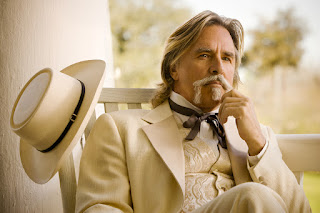 I too love the "like Jerry" dialogue. It plays as such a great "in the
know" moment, like the one in Jackie Brown where Sam Jackson is
surprised to find Robert Forster likes The Delfonics. I was surprised at
the laser accuracy of Big Daddy's comparison. Wow, I thought, QT knows
about this? As I said in my Song of the South piece, these rich ass
landowners had both race AND class problems. The only reason that poor,
redneck cracka Jerry isn't picking cotton for Big Daddy is that Jerry's
not Black. He exists in some kind of classist limbo--too good to be a
Nigra but not good enough for much else. The same holds true today; I
truly believe that if working class Whites realized that "redneck" is
the same as "ghetto," that is, to the rich politicians who use race to
scare them into voting, they're just as broke and niggerish as we are,
there would be a true class revolution in this country. A Tale of Two Cities would have nothing on the moment poor Blacks and Whites tuned out
the noise and found this common bond. Bill O'Reilly can get all Calvin
Candie with his "brown people want something" speech subbing for
Candie's "Nigras are built for servitude" monologue, but his viewers are
only going to believe that shit for so long.
Regarding Corbucci:
 The title Django Unchained pays tribute to the numerous "sequels" to
Sergio Corbucci's 1966 spaghetti western, movies with titles like
"Django Kill!" But I saw more influence from Corbucci's masterful 1968
classic, The Great Silence. Corbucci's movies are amoral affairs, bleak
as hell and equally as violent. Django Unchained's blood-spattered
cotton has an older brother in the blood-stained snowy landscape of
Silence's Utah setting. Silence also has a plot dealing with Black
vengeance, here embodied by Vonetta McGee's hire of the mute outlaw
Jean-Louis Trintignant. Trintignant's job is to kill the man who shot
McGee's husband. Klaus Kinski is the target of McGee's revenge, and you
know NOTHING good comes from irritating Klaus Kinski. The hired
gunslinger cares not what color McGee or her husband is, despite the
fact it's 1899. Kinski didn't either; he gunned him down for the money.
Silence is notorious for its downer ending, which is truly stunning and shocking. Tarantino decides to go a different route, one that our mutual friend Kevin B. Lee and I discussed in a recent chat. Lee thought QT let viewers off the hook by drawing his lines of good and evil too broadly. I countered that two scenes could be used to dispute this:
1. The aforementioned dog-attack scene, where Foxx's Django, in playing his role, basically signs the runaway slave's death certificate. There's both a Corbucci-esque amoral coldness to that scene, and it adds some complexity to Django's character. We know he's playing a role to save his ass, much like Jackson's house nigger, Stephen. In that moment, Stephen and Django have something in common--survival at any costs. Stephen is far more reprehensible, as he's in a position of power of sorts by having Massa's ear, but his actions, like Django's, serve selfish purposes. For Django, it's to save Broomhilda; for Stephen it's the old Simon and Garfunkel line: I'd rather be a hammer than a nail. After witnessing the dog scene, I thought of Sam Fuller's White Dog, where Paul Winfield hides a murder for the selfish reason he believes he can change White Dog's racist conditioning.
2. I thought it clever that the last showdown in Django Unchained is between Stephen and Django. Stephen is suspicious of Django from the get-go, and to save his ass, he rats Django out. Django's revenge segues into the film's explosive "happy ending," but Jackson's last lines of dialogue lend our catharsis a troubling uncertainty. Our heroes ride off into the sunset, but what awaits them at the dawn? "They'll hunt you down!" Stephen yells, and I'm sure they will. So I don't think we're let off the hook. This is just a momentary moment of joy for the reunited couple. It lacks the explicitness of The Great Silence's downbeat ending, but under the surface it doesn't promise a happily ever after in any regard.
Since I'm dragging our mutual friends into this conversation, I'll mention Bilge Ebiri's tweet from December 30th:
"Would King Schultz in DJANGO UNCHAINED count as a Magical Whitey?"
Boone Sez:
"The fact that Schultz's ruse ultimately serves to turn a slave into an avenging outlaw is fucking thrilling to my black eyes."
So I guess the answer is yes! I love King Schultz because of his use of language as a tool of empowerment. English is his second language, yet he speaks it better than anybody he encounters. More than once, a White person asks him what the fuck he's talking about. Schultz uses his SAT words in as vengeful a way as he uses his guns. In both instances, the targets don't know what hit them. Broomhilda's German fluency is Tarantino's not so subtle way of linking her to his brilliant stand-in (I think QT sees himself as Schultz). He's saying "see! We can speak the same language, therefore we're not so different." The German bond is also yet another way for Django Unchained to use language as a weapon to bludgeon the ignorant. Nobody else at Candieland knows what those two are chattering about, but I like the fact that only Stephen is concerned. Unlike his Massa, he knows that Black folks can be conniving and crafty. The thought never crosses these racist asshole's minds, from Candie on down to Purlie Victorious' Cap'n Cotchipee.
To close out, thank you for bringing up colored compassion in Hollywood cinema, and more specifically, The Color Purple. I too roll my eyes and say "fuck you" to anybody who comes at me with the standard issue criticism of that movie. It's our true epic, such a rich emotional cinematic experience that I can forgive any and all of its sins. Spielberg allows Glover to play those conflicted notes, just as Tarantino trusts Foxx enough to signal his feelings to the audience. Unlike most Spaghetti Western heroes, there is something going on behind Django's steely mask, which is more than can be said for any Negro in a Black and White buddy movie. Except Running Scared, of course.
You get the last word, my brother!
Round 6: Boone
I read the ending of Django Unchained the same way I read the last shot of Taxi Driver (another film referenced here, not just for the gun-up-the-sleeve contraption), as a possible delusion of the doomed protagonist. Everything that happens after Django's final killing spree has the quality of a revenge dream. I almost expected him to wake up still hanging upside down in the barn, the way Mr. Tuttle found himself still bound in a torture chamber after his escape fantasy in the movie Brazil. The plantation explosion happens so Looney Tunes-style close to Django, and Broomhilda's reaction is that of a winning game show contestant, not a 19th Century slave who has spent her life being raped and tortured. It's a demented kind of happiness that reminded me of Andre 3000's green casket sitting in the middle of his teenybopper-giddy "Hey Ya!" video (to carry a Wesley Morris observation that much further). Whatever Tarantino's feeling about this ending, it chilled my blood worse than anything in Ken Burns's The Central Park Five.
Sticking to the supposition that what happens after Django's killing spree is pure hallucination and/or Tony Kushner-style theater, I'll say that Stephen's speech to upside-down Django is a theatrically lit "Message to the Black Man in America." Instead of Elijah Muhammad delivering it, the ultimate Uncle Tom tells us, by implication, what young black men like Django are to expect from their new homeland for the next 154 years. Damn. Notice how he looks straight into the camera during this monologue, eyes wider and sadder than you'd expect of this venal sellout. My friend Soledad Socorro went further, telling me that Stephen's describing a lifetime of chopping "big rocks into little rocks" is a nod to the modern day prison industry (and maybe even the crack game!); that his phrase "everyday, all day" sounds suspiciously like the self-diminishing boast of 'hood knuckleheads everywhere.

"American Slavery Was Not A Sergio Leone Spaghetti Western. It Was A Holocaust. My Ancestors Are Slaves. Stolen From Africa. I Will Honor Them."
 Why was all this time devoted to Shelton? If he had the
power CNN assigned to him, his superb documentary Bad 25 wouldn't have
been butchered and crammed up ABC's ass on Thanksgiving evening. I'm a little
sick of the media turning to (and on) Spike whenever something seems racially
fishy. There are far angrier Black men out there, but nobody would have
asked, say, Chuck D, for his opinion, because scared White readers
wouldn't know who the fuck Chuck D is. So, Lee complains and suddenly HE
IS SPEAKING FOR NEGRO AMERICA even though Lee explicitly stated his
opinions are his own. But I think it's comments like Lee's that prevent
our history from being depicted onscreen in any fashion. Last thing
anybody wants to do is be considered disrespectful or a racist.
Slavery for us is like the Crucifixion for Christians, that is, a topic that is held in such regard that it can't be examined in any thematically controversial way. We need to see things like Django Unchained and other interpretations and responses. We deserve and demand to see them. We don't, however, because Black folks are too scared to confront these images and White folks are either too scared (for different reasons) or fear it won't make any money. Black filmmakers will feel visual guilt; White filmmakers will be accused of liberal guilt.
For years, I hoped Lee, or any Black director for that matter, would turn his or her attention to giving us a slavery based movie from a literally Black point of view. Our backstories are rich and endlessly dramatic. Yet how many Black directors have even been CLOSE to making an epic movie about slavery? We've seen our perspective in books (Toni Morrison's Beloved), and on stage (August Wilson's The Piano Lesson, for example), and on TV (Roots), but we've not really seen this perspective on film. Lee could get it done. I would have loved to have seen Spike Lee's Beloved, or his take on Nat Turner. Especially his take on Nat Turner! But no, I just get complaints.
Granted, with slavery epics buoyed by both Oprah and Spielberg failing to make paper, the financing wasn't there in Hollywood. But why not a low-budget indie? You don't need $100 million worth of CGI, because aliens don't run plantations. Get a kick-ass script, find a field down South, get some ashy muthafuckas with raggedy clothes on, some sinister looking White people, and voila! There are stories to be told out there, and with a lived-in funkiness to them, not the stifling beatification that can only serve to mar creativity.
 After Inglorious Basterds, I said "I bet nobody would try that shit
with slavery." And here we are, with Django Unchained, which I consider a
ballsy move on Tarantino's part. He knew the kind of backlash he could
face, and like all crazy ass people, he didn't let it hinder the need to
satiate his compulsions. It's not just an homage to spaghetti Westerns,
it also tips its hat to the many prior Black movies that dared put a
bruva on a horse and give him a gun, from Poitier's Buck and the Preacher to Margheriti's Take a Hard Ride to the numerous lousy vanity vehicles Fred Williamson crafted for himself in Blaxploitation days.
This wasn't our first time to the rodeo; in fact, we invented some of
that rodeo shit.
So, we have a vehicle that puts a Black man in a position of vengeance, gives him guns and has him shoot up plantations owners and other racists left and right, with maximum carnage splattered all over the screen. Underneath that lay some truly disturbing material that shook me to my core if only for how easily I could draw parallels to what's happening today. But from a purely basic instinct, like the Blaxploitation flicks of our youth, Django Unchained provided me with a sense of fantasy empowerment; after listening to months and months of shit about Obama and poor people, Jamie Foxx shooting racists made my dick hard.
So why the hell are folks losing their damn minds about this movie? Let's discuss the many ways it stuck with us, for better and worse.
Round 2: Boone
You ask why folks are lavishing so much attention on Mr. Lee? I think because we all know Django Unchained is the kind of film we'd love to see him make, something bold, angry, vulgar, tender, musical and sublime about American Slavery. You're dead-on about a Nat Turner Spike Lee Joint. Now that Tarantino has used his clout to initiate a historical subgenre that should have gotten going at least as early as Buck and the Preacher, Spike should tackle his own antebellum epic. Nat Turner, Frederick Douglass, Harriet Tubman--so many of those proud ancestors that Mr. Lee invoked are waiting patiently for beautiful films that honor them. The best way to honor them is not with tasteful, funereal reverence but some real attempt to measure the dimensions of the stretch of history they occupied. The units of measure are various; whether the storyteller's measuring tape skews moral, spiritual, political, anthropological, patriotic or mythic, the richness of the fabric always depends upon his regard for people as people. I might have shown a little more love to Spike in my piece, given the beautiful moments of compassion and insight scattered throughout his filmography, but I maintain that QT, for all his love of trash and gore, expresses a more consistently generous and soulful sensibility

"KEEP FIGHTIN, NIGGERS!"
Odie sez:
"Get a kick-ass script, find a field down
South, get some ashy muthafuckas with raggedy clothes on, some sinister
looking White people, and voila! There are stories to be told out there,
and with a lived-in funkiness to them, not the stifling beatification
that can only serve to mar creativity."
Now, you see there? [said in a Bill Duke-in-Menace II Society voice] You see what you done did there?
You just articulated Big Media Vandalism's reason for being, Any young
filmmaker growing up in the kind of hoods we grew up in should browse
this site and find in your essays reasons to push forward with their
dreams, money and connections be damned. Is Django Unchained destined to
be the greatest American slavery epic for all time? Hell no, not even
close. QT has said it himself, that he is just throwing the first rock
through the window. I promise you, some kids in Atlanta, Detroit, Gary,
Watts or, shit, Honolulu will astonish us all with their artful filmic
interpretation of American history, made with Best Buy equipment.
And Spike has made self-effacing comments similar to
QT's in the past, saying that he's more of a pioneer in so-called black
cinema rather than a Mozart or Coltrane-level virtuoso. But that
shouldn't stop him from continuing to challenge and provoke with his
best weapon--and it ain't Twitter.
Anyhow, what are some of your favorite moments in
Django, nigga? You told me you love it. That's a bold statement from a man with
such high standards. At what point in this movie did you realize you
were in love?
Round 3: Odie
Last night, I dreamed a dream--no, not like Anne Hathaway! I would NEVER let a camera get that close to my face--my dream was of some young bruva emerging from the ether, a tripod-clad video camera slung across his shoulder like John Henry's hammer. "My brother," he said to me, "the drought is over." He sat me down, flipped the viewer of his camera my direction, and pressed play. I don't remember exactly what he showed me, but I do remember the feeling I had when it was over: I was jumping up and down, applauding wildly. This was the cinematic statement on my ancestors for which I'd been hoping. I woke up with a smile on my face.
It's nice to dream.

Well, maybe not.
Django Unchained isn't my dream scenario's epic statement, but it is the loud noise atop the snow-covered mountain, the sound that will hopefully cause the avalanche. You asked for my falling-in-love moment, and I've many to choose from, but I'll go with QT's placement of Jim Croce's I Got A Name. It's both blatantly obvious and surprisingly touching. Django is surprised King Schultz would allow him to pick out his clothing ("and you chose THAT?" asks the slave girl giving Django the tour of Big Daddy's Bennett Manor estate), and put him atop a horse of his own. Croce's lyrics resonate in ways I hadn't given thought to despite my familiarity with the song. As subtly as Tarantino can muster, he presents the gift of humanity to a former piece of property. I daresay I was profoundly moved.
That's the polite Negro in me speaking; the hoodrat would go with the moment Django opens fire on the Brittle brothers. "SHOOT THOSE FUCKERS!" I heard my inner voice yell. You can take this boy out of Blaxploitaion, but you can't take the Blaxploitation out of this boy.
Boone sez:
"And Spike has made self-effacing comments similar to QT's in the past, saying that he's more of a pioneer in so-called black cinema rather than a Mozart or Coltrane-level virtuoso. But that shouldn't stop him from continuing to challenge and provoke with his best weapon--and it ain't Twitter."
Lee's most profound moment for me is an image in one of his forgotten earlier films. I loved Reggie Bythewood's Get on the Bus, which explored several different types of Black men en route to the Million Man March. Two of the characters, a father and son, are shackled together, if I recall correctly, because the son is under some form of house arrest. Lee's last shot is of those shackles, broken and cast aside. Tarantino does not have an image that loaded and coded in Django Unchained, and I don't think it's his intention to do so. Both men are provocateurs, but Lee's artistic provocations often stem from unpopular, uncomfortable viewpoints. Mainstream viewers are challenged, even in Lee's worst offenses like She Hate Me, by a (figurative and literal) minority opinion.
Django Unchained attempts to mine those unpopular opinions a bit, because as your Texas-published textbook and GOP politicians will tell you, slavery wasn't that bad. And as a certain blonde Republican correspondent's book will tell you, racism is over, so there's no need to
"KEEP FIGHTIN, NIGGERS!"
Unlike the Nazism QT's heroes combat in Inglorious Basterds, slavery makes America the villain. The American way of life at the time is the bad guy here, and this creates a discomfort that I've seen reflected in several reviews: "Where's the morality in Django?" I acknowledge that Inglorious Basterds adds a morally ambiguous layer to its heroes, whereas Django Unchained is more a product of QT's love of Blaxploitation and the Sweet Sweetback notion of a "baadasssss nigger comin' back to collect some dues." Why is that wrong?
Yet, Tarantino knows that, as a White man, he processes his rage against the institution of slavery differently than Blacks. I can make this statement based on the mini-arc he crafts for Dr. King Schultz. When Leonardo DiCaprio's Calvin Candie authorizes his lackeys to turn the dogs loose on his runaway slave, Waltz's Schultz is clearly shaken. Foxx's Django remains unsurprised, and even somewhat complicit. The latter I'll talk about next time, when I pitch the art of slave role-playing as a side hustle. The former is made explicit in dialogue: "Your man looks a little green," Candie says to Django. "He ain't never seen a man torn to pieces before," Django responds. Later, it is Schultz who has the flashback to that horrible sequence, and the fact that it's so new to him contributes to his fate. Django is also angry, but like most Black folks, that anger is both stoked and tempered by a sad familiariity, a "been there, seen that" stoicism stitched into our DNA by the experiences of both our ancestors and our contemporaries. (Think about how you feel when you hear about police shootings et al.) Touches like this are what haunts me about Django Unchained.
What also haunts me is how much DiCaprio's major speech sounds like the shit we heard on Fox News during this election cycle, and especially after Obama won the election. "Oh, he won because brown folks wanted something." I'll come back to that, too.
 I want to close out with something else that made me love this
movie: The way people reacted to seeing something as commonplace
nowadays as a Black man on a horse. Everybody, both White and Black,
react as if Django rode into town butt naked and under a White woman.
"Who's this nigga up dere on dat nag?!!" Sam Jackson's Stephen asks in
one of his first lines of dialogue. These reactions, and the scenes with
the Klan, have led reviewers to compare Django Unchained to Blazing Saddles. That's a fucking lazy observation, because in Blazing Saddles,
Black Bart rides into town with an empowering sheriff's star, and THAT'S
what the "God-fearing citizens of Rock Ridge" are reacting to, not to
him being on a horse. Django has no observable, nor symbolic powers.
Sam Jackson and Christoph Waltz were born to speak QT's dialogue--both are excellent here--and I want to get your take on both of their roles. Also, you said to me "this film won't leave me alone." Expand on that, my brother.
Next time, I want to talk a bit about Tarantino's directorial influence, Sergio Corbucci, and his film The Great Silence.
Round 4: Boone
This movie won't leave me alone because I, too, fell in love with it. The first swoon was during the scene where King and Django have a teachable moment over beers in a saloon while waiting for a Sheriff to come arrest them. That sequence is the essence of what a lot of Tarantino detractors deny exists: his restraint. The hilarity of that series of negotiations and killings is all about rhythm, pace and QT's delight in his stylized characters. It's also the first scene to establish Schultz's M.O. of exploiting his own whiteness to the fullest. He uses his race and refinement like a CIA asset whose swarthy complexion and command of Arabic lets him move freely through the Muslim and Arab world. The fact that Schultz's ruse ultimately serves to turn a slave into an avenging outlaw is fucking thrilling to my black eyes.

This is like that beer summit Obama engineered between Henry Gates and that cop...
The second swoon was the entire sequence at Big Daddy's plantation, Bennett Manor aka Miscegeny Heaven. This is just one of the funniest, most exciting pieces of film I have ever seen. If I had to be a cotton-pickin slave, I'd prefer Don Johnson's farm over DiCaprio's Candieland, since it most resembles the world we live in, where folks can live pretty harmoniously so long as there's ample distraction from routine cruelty and injustice. From Hal Ashby to Aaron MacGruder, I can't think of too many exchanges of comic dialogue between races as mercilessly true as the one between Big Daddy and Bettina about how to treat Django. Oh, the many times in my life I have been treated "like Jerry."
The Jim Croce montage that affected you was
maybe the fourth or fifth swoon for me, but it struck me only on a
second viewing. It's always nice and sweet to see effortless brotherhood
between black and white set to music. I think this one has more sincerity and replay value than any of Paul McCartney's 80's negro collabos, despite being just as ridiculously on-the-nose.
Odie sez:
"Yet, Tarantino knows that, as a White man, he processes his rage against the institution of slavery differently than Blacks. I can make this statement based on the mini-arc he crafts for Dr. King Schultz."
"Yet, Tarantino knows that, as a White man, he processes his rage against the institution of slavery differently than Blacks. I can make this statement based on the mini-arc he crafts for Dr. King Schultz."
Agreed. The schism of perception between Django and
ultra-cultivated European Schultz reminds me of hood rat Diana Sands'
line to blueblood Beau Bridges in The Landlord about "growing up
casual." Yet we see, just by the way QT lingers on Foxx's face when the
atrocities are happening, that Django is only playing the ice cold role
expected of him. His conscience and morality bleed just like Schultz's.
It's too bad that he didn't get at least one traumatized flashback
related to somebody who wasn't him or his wife. What a lot of terribly
ignorant, hostile people out there need to see are more images of black
men experiencing what in American film history has largely been a white
phenomenon: compassion. (That's why can't nobody say nothing bad bout
The Color Purple to me. Danny Glover's Mister is a glowering black
villain for much of it, sure. But the hints at his torment along the
way, and the shot of him watching Celie and Nettie's reunion at the end
showed more of a fully human arc than 99% of
Magical/Villainous/Utilitarian Negro roles offered by white filmmakers.)
Django on a horse: That ain't nothing but a Black
Man in a Cadillac, a searing eyesore for a certain segment of this
society, even today.
Tell me some stuff about
Corbucci and that snowy flick he made that Django UC seems to be so
smitten with. Influences? So many, from everywhere. At one point Django
looked like Sammy Davis Jr. in his episode of The Rifleman.
QT is one of us. By "us" I mean, of course, an obsessive film critic.
Round 5: Odie
Regarding Corbucci:

Silence is notorious for its downer ending, which is truly stunning and shocking. Tarantino decides to go a different route, one that our mutual friend Kevin B. Lee and I discussed in a recent chat. Lee thought QT let viewers off the hook by drawing his lines of good and evil too broadly. I countered that two scenes could be used to dispute this:
1. The aforementioned dog-attack scene, where Foxx's Django, in playing his role, basically signs the runaway slave's death certificate. There's both a Corbucci-esque amoral coldness to that scene, and it adds some complexity to Django's character. We know he's playing a role to save his ass, much like Jackson's house nigger, Stephen. In that moment, Stephen and Django have something in common--survival at any costs. Stephen is far more reprehensible, as he's in a position of power of sorts by having Massa's ear, but his actions, like Django's, serve selfish purposes. For Django, it's to save Broomhilda; for Stephen it's the old Simon and Garfunkel line: I'd rather be a hammer than a nail. After witnessing the dog scene, I thought of Sam Fuller's White Dog, where Paul Winfield hides a murder for the selfish reason he believes he can change White Dog's racist conditioning.
2. I thought it clever that the last showdown in Django Unchained is between Stephen and Django. Stephen is suspicious of Django from the get-go, and to save his ass, he rats Django out. Django's revenge segues into the film's explosive "happy ending," but Jackson's last lines of dialogue lend our catharsis a troubling uncertainty. Our heroes ride off into the sunset, but what awaits them at the dawn? "They'll hunt you down!" Stephen yells, and I'm sure they will. So I don't think we're let off the hook. This is just a momentary moment of joy for the reunited couple. It lacks the explicitness of The Great Silence's downbeat ending, but under the surface it doesn't promise a happily ever after in any regard.
Since I'm dragging our mutual friends into this conversation, I'll mention Bilge Ebiri's tweet from December 30th:
"Would King Schultz in DJANGO UNCHAINED count as a Magical Whitey?"
Boone Sez:
"The fact that Schultz's ruse ultimately serves to turn a slave into an avenging outlaw is fucking thrilling to my black eyes."
So I guess the answer is yes! I love King Schultz because of his use of language as a tool of empowerment. English is his second language, yet he speaks it better than anybody he encounters. More than once, a White person asks him what the fuck he's talking about. Schultz uses his SAT words in as vengeful a way as he uses his guns. In both instances, the targets don't know what hit them. Broomhilda's German fluency is Tarantino's not so subtle way of linking her to his brilliant stand-in (I think QT sees himself as Schultz). He's saying "see! We can speak the same language, therefore we're not so different." The German bond is also yet another way for Django Unchained to use language as a weapon to bludgeon the ignorant. Nobody else at Candieland knows what those two are chattering about, but I like the fact that only Stephen is concerned. Unlike his Massa, he knows that Black folks can be conniving and crafty. The thought never crosses these racist asshole's minds, from Candie on down to Purlie Victorious' Cap'n Cotchipee.
To close out, thank you for bringing up colored compassion in Hollywood cinema, and more specifically, The Color Purple. I too roll my eyes and say "fuck you" to anybody who comes at me with the standard issue criticism of that movie. It's our true epic, such a rich emotional cinematic experience that I can forgive any and all of its sins. Spielberg allows Glover to play those conflicted notes, just as Tarantino trusts Foxx enough to signal his feelings to the audience. Unlike most Spaghetti Western heroes, there is something going on behind Django's steely mask, which is more than can be said for any Negro in a Black and White buddy movie. Except Running Scared, of course.
You get the last word, my brother!
Round 6: Boone
I read the ending of Django Unchained the same way I read the last shot of Taxi Driver (another film referenced here, not just for the gun-up-the-sleeve contraption), as a possible delusion of the doomed protagonist. Everything that happens after Django's final killing spree has the quality of a revenge dream. I almost expected him to wake up still hanging upside down in the barn, the way Mr. Tuttle found himself still bound in a torture chamber after his escape fantasy in the movie Brazil. The plantation explosion happens so Looney Tunes-style close to Django, and Broomhilda's reaction is that of a winning game show contestant, not a 19th Century slave who has spent her life being raped and tortured. It's a demented kind of happiness that reminded me of Andre 3000's green casket sitting in the middle of his teenybopper-giddy "Hey Ya!" video (to carry a Wesley Morris observation that much further). Whatever Tarantino's feeling about this ending, it chilled my blood worse than anything in Ken Burns's The Central Park Five.
Sticking to the supposition that what happens after Django's killing spree is pure hallucination and/or Tony Kushner-style theater, I'll say that Stephen's speech to upside-down Django is a theatrically lit "Message to the Black Man in America." Instead of Elijah Muhammad delivering it, the ultimate Uncle Tom tells us, by implication, what young black men like Django are to expect from their new homeland for the next 154 years. Damn. Notice how he looks straight into the camera during this monologue, eyes wider and sadder than you'd expect of this venal sellout. My friend Soledad Socorro went further, telling me that Stephen's describing a lifetime of chopping "big rocks into little rocks" is a nod to the modern day prison industry (and maybe even the crack game!); that his phrase "everyday, all day" sounds suspiciously like the self-diminishing boast of 'hood knuckleheads everywhere.
I gotta go watch The Great Silence with your Corbucci thoughts in mind. Juicy, juicy.
Your
analysis of Django's and Stephen's motives feels right on. They are
only maneuvering to save themselves, which is enough to carry the drama
and establish the horrors of slavery in the context of their struggles,
but it leaves us something much more beautiful and restorative to look
forward to in the future of American cinema: true epics about the real
men and women who did much more than just save their own asses. From
abolitionists to civil rights activists, the to-do list is longer than
the road to Candieland. We'll need a filmmaker with as much lust for
(onscreen) life and light as Tarantino to make it pop the way it needs
to pop.
But I'm afraid we'll also need a filmmaker who has
actually lived in unremovable black skin to make it sing the way it
needs to sing.
It would be just as much of a
thrill to have a white filmmaker prove me wrong on that last point as it
would be to have a black filmmaker meet the "lust for life" challenge
in ways that so many technically proficient Ho'wood nigroes have proven
too cynical and calculating to pull off. I hope that makes a lick
of sense. I mean, so much of the product that Bankable Black Directors
(BBD's (TM)) have put out since the so-called African-American New Wave
makes me wonder if the Django line, "Keep fightin', niggers!" is lifted
from a development exec's memo:
"Y'all want this script for Soul Plane 5: Belly's Revenge or not?"
One great thing about exchanges like ours is that we
get to demonstrate how two brothers can agree or disagree without it
becoming either boring (I hope) or a Mandingo fight (you'd win). We may
or may not be as tough as Django, but that's no controversial call,
either way. The notion that brothers like us can hang with the wily,
unpredictable intelligence of a Schultz is still outrageous, judging by
the movies we get. Schultz may be Magical in Django Unchained, but in the history
of Ho'wood, he's just your average white Superfly.

"I know you knows dem jimmies that wrote this piece!"

