Wednesday, May 13, 2020

Celebrating Stevie: List Four: 10 Wonderful Surprises

by Odienator


Happy 70th birthday, Stevie Wonder!

This is a milestone for one of the greatest singer-songwriters in the history of music! As a fellow Taurus and a lifelong fan, I salute his longevity, his activism and his love of humanity. And of course, I worship his talent, as evidenced by the three list-like pieces I wrote about him here at Big Media Vandalism back in 2013 and 2014. I say "list-like" because, besides my number one choices, the other numbers really don't mean shit. I just put them in to troll you AND I told you this up front. I also told you this was not a "best of" list series in ANY REGARD. Some of you jackasses still wrote me to complain about ordering and what I left off.

I had no intention of writing a fourth list because this project was designed as a trilogy and my math degree will not allow me to squeeze a fourth item into something meant for exactly three items. But this is a milestone May birthday not only for Stevie but for me also. On May 11th, I turned 50, which means my mother was rocking my cradle in time with my favorite Stevie song, Signed, Sealed, Delivered I'm Yours. That came out in June of 1970 and was written by a 20 year old with three prior Grammy nominations under his belt and 25 Grammy wins ahead of him. (He'd lose for this song, however, to nasty ol' fellow blind man, Clarence Carter's Patches.)

Stevie's first hit was 57 years ago. Just think about that for a second. I went to Wikipedia to see what you get for your 57th anniversary. You don't get shit. It's an off-anniversary! But for your 70th anniversary, you get Platinum. And what is a birthday but an anniversary of your marriage to life? Of course, Stevie got his platinum long before turned 70. In fact, Hotter than July went platinum was Stevie was 30 and I was ten.

So, trilogy be damned! The man deserves another list, not just on the 70th anniversary of his life but as a 50th anniversary present for my own battle with life.

This is the fourth of what was originally three lists of Stevie Wonder songs. The lists are here and you should read them in this order: 
  1. Love is Wonderful
  2. Peace, God and Protest  
  3. What the Fuss? 
For a fourth list, I needed a new concept. I had already done the random thing (see list 3), love songs and protest songs. So this one is all about Stevie Wonder surprises. I won't define what a "surprise" is; that's on you to figure out. I will say that one of the songs on this list is the worst song Stevie ever wrote. The rest of them are great songs at best, good and intriguing songs at worst.

Since I know y'all hate reading and love bitching, here's a handy list of the 40 songs I've already covered in this series. 

On with the show! As if I need to remind you: The numbers don't mean shit!

Herewith: 10 Wonderful Surprises.

10. Faith- My first pitch on the mound is a batshit curveball! No, this isn't a remake of George Michael's classic solo debut single (though I'd empty my bank account to see Stevie shaking his ass in a pair of tight jeans while strumming a guitar in a remake of that song's video). This is a song on the soundtrack of the animated feature Sing, a duet between Stevie and Ariana Grande. Now, I'm way too old to even know who Ariana Grande is, but age didn't stop Stevie. How you stick around in this industry is by letting future generations know who you are. By teaming up with Grande for a cartoon, Stevie's all but guaranteeing that the grandkids of his original fans will also know who he is. And sue me, but the song's kinda catchy, especially when Stevie works the chorus. This is the only entry where I'll tell you what the surprise is: Despite what imDB tells you, this is the only song in this entire series that Stevie Wonder did not write.

9. I Ain't Gonna Stand for It- Remember when I said this list contained the worst song Stevie ever wrote? Well, this is it! My fellow Henderson, Eric Henderson, likes to tease me about this song and how misguided my choice is. Back in list one, I went to bat for what everybody else thinks is Stevie's worst song. I disagree with y'all's choice, and so did the Academy Awards. To quote Stevie, "somebody's been pickin' in ya charry trayyy!"


"My album still went platinum, Odie. So, you can kiss my Natural Black braids!"

Here's the thing: I Ain't Gonna Stand for It isn't a bad song by itself. I really appreciate that Stevie followed in the country music footsteps of Georgia's own Ray Charles, The Commodores' own Lionel Richie and Oakland's own The Pointer Sisters (who won a Grammy for their masterful country song, Fairytale). But they had something Stevie doesn't: They can master a Southern accent, either by default (Richie's from Alabama, for Cripe's Sake) or by mimicry (Anita, June, Bonnie and Ruth Pointer). Stevie cannot pull this shit off. Perhaps this is the ONLY thing Stevie can't do well. Get some White boy with a twang--or Hootie--to sing this, and we might be onto something here.

I kinda think Stevie's fucking with us on this one by making his "Southern" drawl intentionally bad. Be that as it may, it still torpedoes the song! No matter: Bad Stevie is still better than most people's masterpieces.

8. Maybe Your Baby- Stevie's "heart is blazing like a 5-alarm fire" and the lighter fluid is the incredibly funky music underneath his vocal. You can easily tie this second song on Talking Book to at least two of Stevie's later hits: The perfect groove on You Haven't Done Nothin' ups the funk quotient exponentially and a certain song on Songs In The Key Of Life takes this song's romantic masochism to a shocking yet appropriate extreme. More on that latter one later. For now, enjoy shakin' ya ass while being taunted by a title-including chorus that toys with your suspicious heart like a cat with a mouse: "Maybe Your Baby done made some other plans!" it teases just before Stevie mutters a word that sounds like "shit!" in frustration. (Listen at around 1:27.) As an added bonus, the electric guitar is provided by the guy Stevie beat for that aforementioned Oscar, Ray Parker Jr.

7. Never Dreamed You'd Leave In Summer- It wouldn't be a Stevie list without a sad song, so here it is. This 1971 collaboration between Stevie and then-wife Syreeta Wright takes a favorite metaphor of his, the seasons, and fashions out of them the hauntingly sad arc of a lover's broken promises. "You said you would be warm love in springtime," Stevie sings, "that is is when you started to be cold." It's important to note how devastated Stevie sounds here--his still-youthful 21-year old voice makes the pain feel like your first heartbreak, you know the one where you thought the world was just going to fucking end. And yet, the words are ageless; the emotionally battle-scarred voice of a 59-year old singer could sell this song on another, equally devastating though more mature level. I know, because this is the song Stevie sang at Michael Jackson's memorial service.

6. We Can Work It Out- Flip the 45 of number 7 over and play this remake. Perhaps the greatest cover of a Beatles song, though the more I think about it, James Brown's take on Something might be a tad better. Like James' version, Stevie takes this in a different direction, respecting the original's composition while remaking it entirely in his image. You can hear John and Paul rattling about in the bones of this thing, but everything else about it is pure Stevie. From the distorted opening notes, to the harmonica solo in the middle, to the surprise of the tambourine shaking during the "life is very short and there's no time" bridge, this is how you do a cover. The subject matter is also a perfect fit for the man who sang a helluva lot of songs of peace, love and protest. 

5. Creepin'- There's a reason Lufer, I mean LUTHER Vandross chose this as the afterglow to follow the astronomical sex of his biggest baby-makin' hit, If Only For One Night. This is as mellow smooth as Maxwell, a relaxing moment of introspection as you try to catch your post-coital breath. Stevie also has it follow a song about fuckin' on Fulfillingness' First Finale, but that song is the uptempo jam Boogie on Reggae Woman, perhaps the raunchiest song in Wonder's canon. The ass is so good in both the songs that precede it that the person has become your own personal Freddy Krueger. "Why must it be that you always creep in my dreams?" asks Stevie before describing what sounds like Wet Dream on Elm Street: "When I sleep at night, I feel those moments of ecstasy." Add to this a sweet harmonica solo, a hesitant moment of doubt and the impeccable voice of Maya Rudolph's Ma Minnie Riperton on backgrounds and you've got a romantic keeper.

Master Song Thief Luther ALMOST steals this song from Stevie. Almost!

4. St. Louis Blues- Remember when Herbie Hancock played them keyboards on Stevie's 2nd greatest song, As? Well, Stevie returns the favor by providing vocals and harmonica on Hancock's take on W.C. Handy's "jazzman's Hamlet." They got some big shoes to fill here, considering that Louis Armstrong and Bessie Smith, Count Basie, Der Bingle, Glenn Miller, Pete Seeger, Billie Holiday, the goddamn Boston Pops AND even Dr. House himself, Hugh Laurie, have taken cracks at it. Did I mention this song is 106 years old? It was 85 when Stevie sunk his teeth into it, and for his trouble, he won two Grammys. This dame he's singing about is a bad mama jama too! "St. Louis Woman with her diamond ring," begins Stevie, "she pulls that man around by her apron strings." Late in the song, he deadpans "if you see me with a St. Louis Woman, slap me before she slap me!" Behind him, this menagerie of animals posing as jazz instruments fill the speakers. I wouldn't dare say Stevie bests Bessie Smith here, but she might well have slapped him for sounding this good had she heard this version.

3. Hey Love- We had young heartbreak on here, so let's have some young love to balance it out. While 70's era Stevie's voice, especially in his major run of albums, brought him the most success and remains the strongest of all his singing eras, I've always been partial to his adolescent voice. You can find it in famous songs like My Cherie Amour and Uptight, but the purity of it on this song is unmatched. I almost went with I Was Made To Love Her here, with its great line about being "knee high to a chicken," and its stronger vocal, but this song had an in: Just like The Temptations' version of Rudolph, this is a song I cannot help but sing a line from whenever it comes on. I could be doing God Knows What anywhere on God's Green Earth, and if this song comes on, I will drop everything to sing "HEY-AY-AY-AY LOVE!!"

2. Ordinary Pain- When Betty Wright died recently, everyone was tweeting The Clean Up Woman and Tonight's the Night in her honor. I tweeted She's Got Papers on Me, a song she didn't get credit for singing. But she's on it with a vengeance! And her appearance is a huge shock. It always made me think of the similar trick Stevie pulls on this song. The first 2:41 of the song is, dare I say, a bit uneventful. It has some wonderful background vocals by Niecy and others but Stevie's lyrics are, to quote Addison DeWitt, "maudlin and full of self-pity." They're so self-consciously so that you start to wonder if every sad love song, even the great ones, is really this way. Stevie even sounds a bit whiny, to the point where you almost want to say "Jesus, man, you're really self-serving and pathetic right now!"

Stevie is fucking with you.

"Lemme take my glasses off for this..."

The song ends, or so it seems, at 2:41. You look at the album cover and go "hey, wait a minute, Stevie! You owe me 3 and half more minutes!" He's going to give it to you alright!

Or rather, Shirley Brewer is going to give it to you. Suddenly, this becomes a funky answer record! You know that woman Stevie was singing about, the one who made him miserable? Well, she's here and she sums up his sad little number in the first line she utters: "You're just a masochistic fool!" she growls, "because you knew my love was cruel!" It's all downhill from there for poor Stevie. She reads him six ways til Sunday, to the point where you almost feel bad about how hard this lady is kicking his ass. It would be unbearable, that is, if you could stop dancing for one second to feel bad for him. Suddenly, all those sad love songs Stevie sang take on a different look! Perhaps those mopey, heartbroken men aren't entirely blameless for their situation! Maybe they wanted it! I've never been more confused while shaking my ass to a record before or since.

1. Fun Day- Folks familiar with this series know of my undying love for the Jungle Fever soundtrack, so this list couldn't end without a song from it. Sometimes, Stevie Wonder songs are just unrepentant odes to joy. Innervisions contains his masterpiece in this regard, Don't You Worry Bout a Thing. "This song makes me happy," I wrote about Thing back in list 2. "That's all I want to say about it." Well, this song makes me happy too, even moreso now that I'm trapped in the house as we all weather that pandemic caused by the Rona. Just listen to the words of this contraption, buoyed by a boisterous chorus of background singers, and let them take you on a carefree odyssey in your mind. "On a day like this, not even bad can rub you wrong," notes Stevie. He even gives you two solos on his most well-known instruments, the harmonica and the piano. It's an IV tube full of good feelings. And it contains a line that I will definitely quote the day I can once again roam around this Earth with impunity: "I cannot believe a day like this has come, that's if this really is." For now, however, I just have this song. And yes, it makes me happy.

Stevie likes messing with the conspiracy theorists, y'know.

Friday, April 03, 2020

We All Need Somebody To Lean On

by Odie "Odienator" Henderson


Music legend Bill Withers died today. He was 81 and no, the Rona didn't get him. According to the Associated Press, Withers died from heart complications. But dead is dead and gone is gone, no matter the delivered route, and this week seems an especially cruel one for music with Adam Schlesinger and Ellis Marsalis also passing away. So, as I sit here trapped in my apartment and my sadness, wondering if I'll yet again see the Harlem Withers once sang about, here are a few words about the guy who, despite his legendary status, will always be Still Bill to those who loved him. 


As a kid, I loved Bill Withers because he sang about his grandmother, specifically how she kept him from getting his ass whupped that one time...

"Grandma's Hands
Boy, they really came in handy--she'd say:
'Mattie, don't you whip that boy
What you wanna spank him for?
He didn't drop no apple core..."


But I was, and remain, destroyed by the line that comes after this:

"But I don't have Grandma anymore."

I lost my grandmother when I was 4 years old. It was my first of many dealings with death in the 50 years I've been on this Earth. I have two memories of her that I cherish and hold dear, both of which I wrote about on this very blog. I remember the long braid of hair she wrapped up into a bun on her head. I recall the religious candles that burned in her room and her telling me about Lana Turner's Imitaiton of Life. I have a vague recollection of her voice. I do not remember her hands, a body part which would have been unmemorable to the kind of 4-year old boy I was.

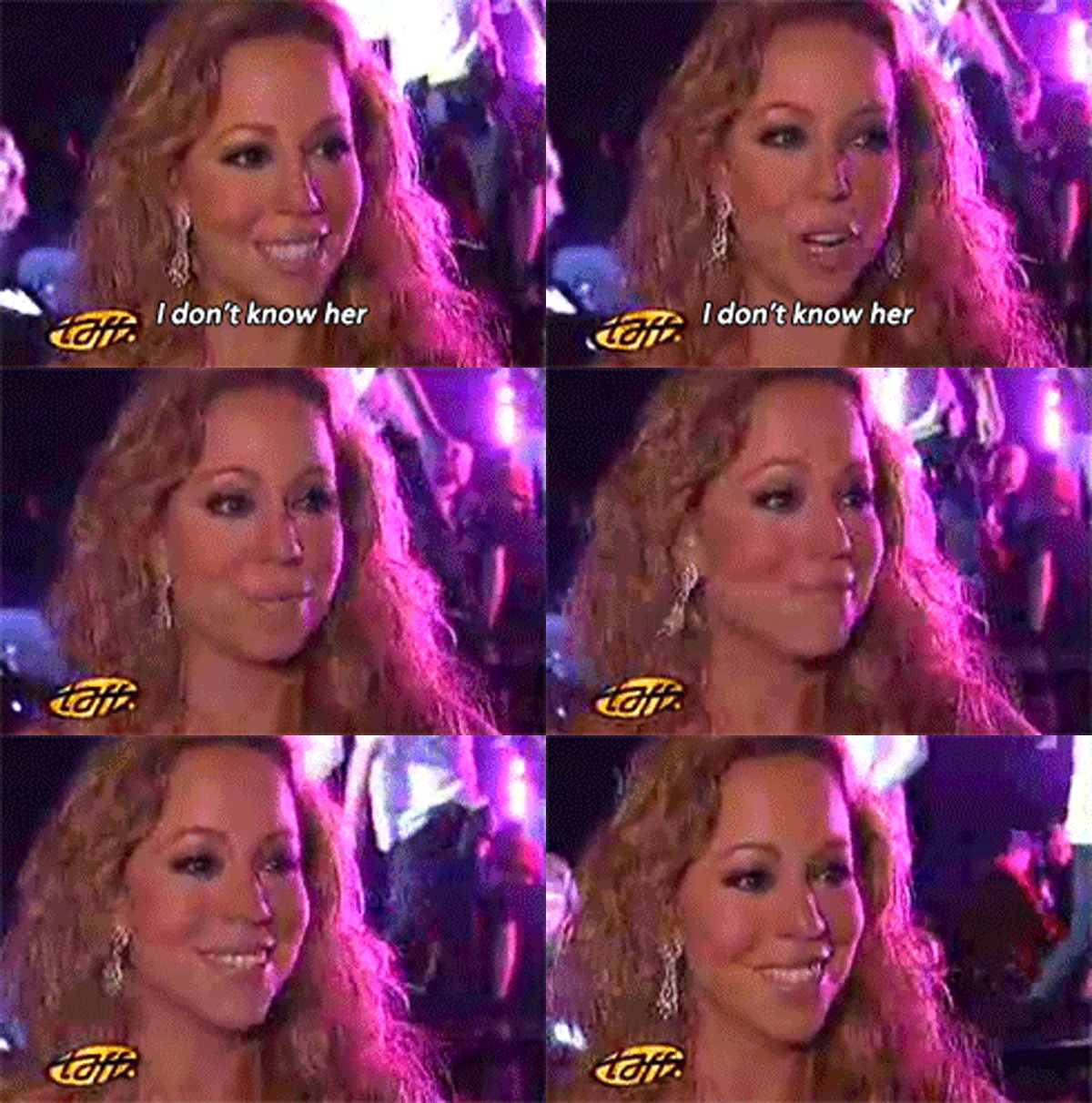
But Bill Withers remembered his grandmother's hands--and his grandmother--far more richly and expliclty than I remembered mine. And so, for the two minutes he sang about her on that record, Bill Withers' grandmother became my grandmother. Or rather, the kind of grandmother I wish I'd had or had lived in my memories. The type of gentle yet firm gramdma I saw my mother become. Nowadays, when my mother acts benevolently after my nieces and nephews do things that would have gotten me shot, I have no idea who this woman is. I feel like Mariah Carey. 


But I digress. Withers' description of his grandmother was so simple, yet he created such a lasting visual in my young mind. I crafted an image of her hands comforting the local unwed mother and shaking that tambourine so well. I felt them picking me up each time I fell. Most importantly, I saw them when they "used to isshuh out a warning." Not issue--isshuh. That glorious West Virginia voice emanating from Bill Withers threw an extra dollop of Blackness on that word and I felt it in my nappy soul the way I felt when Lionel Richie turned value into val-ya and Stevie made something into sumptin'.

God, I loved Bill Withers' voice. The funny thing about it is that, until I was well into adolescence, I had no idea what Bill Withers looked like. Instead, I'd created an entire picture of him in my mind based entirely on that voice. And this wasn't in the late 80's when he disappeared from the limelight, we're talking about the 70's when the man was everywhere.  Hell, he's on the album cover at the top of this piece. We had that album! How on Earth could I not know?

You see, what had happened was...

Back then, I'd never seen the album covers for Just as I Am or Still Bill. Those LPs were just in the white slips that came inside the album covers. My parents used to hide the album covers they thought were too nasty for my curious young eyes. So, I thought Bill Withers records looked like The Ohio Players records. Bill was all sticky because the lady leaning on him was covered in honey--or something like that. When I finally saw him in an old clip singing Lovely Day aka "that song whose impressively long notes make people pass out at karaoke," I discovered Bill Withers looked nothing like I'd envisioned. At least I got the Black part right.


Speaking of Lean On Me, I'm surprised some celebrity hasn't tried to record a new version of Withers' most well-known composition for charitable contributions in this Time of the Rona. Really, there's no need to do that because we have the original song (and the Club Nouveau version if you be jammin', you be jammin' hey). Despite having the most memorable opening chords in soul music history, and despite providing the title of one of the greatest bad movies of all time (and doing so expeditiously, I might add), Lean on Me is my least favorite Bill Withers song. I've heard it 22 million times and despite that rush of excitement I still get when it gets to the hand-clapping "just call on me, brother, when you need a hand" section, its status remains unchanged.

Don't get me wrong--Lean on Me is a masterpiece. But my triffling behind always leaned toward darker, rowdier Bill Withers songs like Who is He and What Is He To You and my all-time favorite, Use Me. The former is a menacing classic, a take on male paranoia so potent Bill doesn't even have to cuss to scare the bejeesus out of the listener; he says daggumit the way Sam Jackson says a certain word beginning with M. It contains my favorite of all Withers' lyrics: "before you wreck your old home, be certain of the new."

The latter song is a magnificently masochistic ode to ass so good it'll make you put up with the emotional mistreatment that goes with it. "You get me in a crowd of high class people and then you act real rude to me," Withers sings here, before adding "but oh baby, baby, baby, bay-baaaay, when you love me I can't get enough!" The exasperated, forceful and horny way Withers delivers that line contains more sex in it than a thousand dirty lyrics. Those who've been there understand, and those who haven't are gonna want to buy a bus ticket to that destination.

Withers could also be heartstoppingly romantic, again using his trademark lyrical simplicity to paint vivid pictures in the listener's heart, soul and mind. "Ain't No Sunshine when she's gone," he sings in the opening line of the lush and buttery Ain't No Sunshine, and that's enough to spark the imagination. And the opening verse of his collaboration with Grover Washington Jr., Just the Two of Us, uses nature to conjure up feelings of love to rival Stevie's best lyrics.

Thankfully, there's an excellent documentary on Bill Withers that you can watch in its entirety on YouTube. Even more thankfully, we have the music of this legendary singer-songwriter to inspire, enrapture and enterain us even as we mourn the loss of his physical presence. With a heavy heart and joy-filled ears, I say rest in peace to the man who not only gave us great music, but who provided the sample for No Diggity. Something tells me Grandma might not have stopped Teddy Riley from getting his ass beat for doing that. Here's hoping that Withers found her when he got to Heaven.


That Bill Withers Doc I mentioned is here

Y'all knew you weren't getting out of here without seeing this.


Wednesday, April 03, 2019

Black Man Talk: Us: Stunning With Scissors

by Odie "Odienator" Henderson and Steven Boone
 
(The following is a conversation between Big Media Vandalism founder Steven Boone and Big Media Vandalism's proprietor Odie Henderson. It is the latest in the Black Man Talk series. Other installments include American Gangsters, Tyler Perry, Django Unchained, 42, Lee Daniels' The Butler, Dear White People, 12 Years a Slave, Sidney Poitier, Get Out and Black Panther)

THIS IS VERY SPOILERIFIC! DO NOT READ UNTIL YOU'VE SEEN US.


Post #1: Odie

Brother Boone,

Time for another Black Man Talk! My proposed topic: Jordan Peele's new horror film, Us. It's already drawn big-league box office numbers and a ridiculous amount of thinkpieces, most of them by White folks just dying to sound woke. More power to them, but let's throw our two cents into this mix.

Speaking of the number 2, Chadwick Boseman originally held the record of two Black Man Talks and now Jordan Peele joins him in the Two-Talk club. I'd love to see what the two of them would do together, but with Boseman's track record of playing every famous brother in history from Jackie Robinson to James Brown, I'd be afraid the Boseman-Peele collab would be about a resurrected Frederick Douglass. Can you imagine Boseman as a pissed off Douglass, with grave dirt still in his hair, ringing the doorbell at 1600 Pennsylvania Avenue and saying to Donald Trump "oh, so I was doing an amazing job despite being dead for a hunnert and fourteen years, huh bitch?" I'd see that movie! Twice!

We know Sam got that role locked up, tho'.

Until we get F.D.'s Revenge, let's focus on Peele's incredibly thorough mindfuck. Like Kubrick, everything in Peele's films is open for interpretation AND seems to have a genuine purpose even it it's only tangential to the main plot. Viewer theories will soon abound and they will not soon abate. Remember that documetary, Room 237, about fan theories relating to Kubrick's version of The Shining? I saw that movie at 8am on a Saturday back when I covered the Toronto Film Festival. I was hung over and in no mood for the incessant ramblings of folks who thought Kubrick used Jack Torrence to confess that he faked the moon landing. Us could beget its own Room 237, but I propose that we not venture that microscopically into Peele's delectable minutiae; sometimes a cigar is just a cigar and a pair of scissors is solely for cutting one's throat.

Besides, everybody knows that Barry Lyndon is where Kubrick owns up to faking the Moon landing. If you listen real closely, you can hear Kubrick whispering "Whitey was never on the moon!" on the soundtrack exactly every 1,969 seconds.*

*that oughta keep the Kubrick zealots busy for a while.

But I digress. I don't scare easily, but Us really got under my skin. Lupita Nyong'o played a major part in that, but let's return to her in a bit. Let me tell you why I felt a strange pang of familiarity while watching this movie.

When I was growing up broke and lonely in Jersey City, New Jersey, I amused myself with a "what-if?" scenario about my life. Like Margaret Mitchell's thot from Gone With The Wind, I swore I'd never go hungry again if I got out the 'hood, but I wondered why I was hungry and poor in the first place. My theory was that there was another Odie, my twin, and that guy got everything I wasn't getting but deserved to have. That other Odie was the beneficiary of a confused God who was sending blessings meant for me to other Odie by accident. He looked down from Heaven and was like "oh, there's an Odie! BLAM! Blessings, bitch!" So, while I seethed as a have not, my doppelganger was getting all the money and the sex and the power earmarked for me when I was placed on this Earth. Granted, the Bible tells us God doesn't make mistakes, but look at the platypus or that big ass dent in the back of my head and tell me that shit wasn't a mistake.

To solve this grievous error, I needed to find Odie Prime. "And I need to kill him!" I thought.

Now I am sure I did not craft this theory on my own. I must have read something similar to it in my literary travels, or maybe heard a story like this. But as Us played out, I thought about those old ideas--things I had totally forgotten about once I became an adult--and it made the motivations of the Tethered and Lupita's twin roles even more intriguing to me. That pang of idea recognition made me think that Us is not just a movie about the privileges and underprivileges of class, it's also about the fear of having what you deserve and/or earned violently yanked away from you by the person behind you on that perceived ladder of success.

The American psyche is nurtured and poisoned by that John Steinbeck misquote that said poor folks see themselves as temporarily embarrassed millionaires. In our lifetimes, this idea really got exploited during the Reagan era, which is where Us places its prologue. We're old enough to remember the cultural climate during Hands Across America. My mother thought it was an incredibly stupid idea to have a chain of people stretching across the country, holding hands like some church Fellowship gone viral, while making a symbolic gesture about the poor. It ran through my hometown on May 25, 1986, exactly a month before I graduated high school, and I did not go down there to participate.

Granted, Hands Across America, along with its sister cause USA For Africa, raised some money, much of it never reaching its destination. But it was such an empty gesture nonetheless, a means of allowing folks to say "I did something" when in actuality they hadn't done shit. It was the probable origin of "performative wokeness," which makes it a perfect metaphor for Peele's Tethered. They're going to do something about their situation besides hold hands and sing a shitty song.

This went to number 65 on the Billboard Chart, folks.

What do you think about my Hands Across America side-eye? And did you notice what everyone's tether looked like, especially the ones played by Elizabeth Moss and Tim Heidecker? Can you think of any film where we followed a dark skinned Black nuclear family anywhere, let alone into a nightmare? And let's also talk about the skin complexion of evil when that evil is Black. And remind me to bring up my own scary trip to Santa Cruz. Perhaps you're talking to my tethered other right now...

...nah, I'm still too many blessings short of a church picnic. It's the real me you're dealing with today.

Ride that escalator down into the depths with me, Brother Boone. The floor is yours.

Post #2: Boone

A lot of recent movies have been labeled conversation-starters but in my experience have only started fights or echo chamber circle jerks (Green Book, y'all?). Us is the first Big Ol' American Movie in a good while that seems alive with spontaneous thought and reflection rather than hashtag cues. Right now there's a cold war happening between the idea of audience as political constituency vs audience as AUDIENCE--distinct human beings going into the dark, hoping to be moved, shaken and even awed by the screen action. Get Out did a more elegant job of the latter than Us, but Us leaves, um, us with a lot more leftovers to take home.

I'm not sure if it's Boone Prime typing these words or my wayward other, but many have suspected that the election of Donald Trump, after an unprecedented year of catastrophes and famous deaths, signaled a detour down a dark alt timeline. Soon Cosby was in prison, Roseanne disgraced, Michael Jackson tried and convicted in the court of HBO. These add up to the pop omen equivalent of birds dropping out of the sky. Us is clever enough to seize the idea of a world askew by tracing back a few decades to the moment the Evil Plan was Hatched. In that sense his project reminds me of my friend, the experimental gonzo filmmaker Damon Packard, whose surreal comedies Reflections of Evil, Space Disco, Foxfur and Fatal Pulse all look back to the 70's, 80's and 90's, searching for the poisoned roots of the present late capitalist nightmare.

Like you, me and Packard (and style-jack auteurs like Panos Cosmatos, Peter Strickland and Ana Lily Amirpour), Peele is Generation X down to the socks. While Millennials are largely interested in burning, skimming, sealing off or upgrading anything from the pop past that seems stale or irrelevant to the Now, Gen X nostalgists remember a time when the past and present existed in a chain of continuity: Then and Now are but different bends of the same river. It's a different approach from, say, Spike Lee (the world's oldest Millennial filmmaker) catering to the youthful BLM notion of "Wow, back in the 70's folks had the same struggles we do now!" which posits that the only thing that has changed are the haircuts. 


A film like Us reflects that everything is always changing, that the dopplegangers are not separated by time (a la the social media memes along the lines of "Look, a pic of a 1908 Jonah Hill lookalike!") but by timeline; that in both the benevolent timeline and the evil one, there are people living out whatever life they've been given, growing older, accruing more experience, wisdom, bitterness, rot, whatever. What doesn't change is a social power structure that foresaw how to maintain its grip on the population, decades in advance. That's the real horror.

We all laughed at do-gooder stunts like Hands Across America, Live Aid, USA for Africa (We Are the World) and Do they Know It's Christmas? but it was a troubled laugh. Underneath it there was a genuine yearning for a world that wasn't so greedy and selfish. We were little kids then, born when everybody from John Lennon to Coca-Cola were trying to get everybody on earth to sing together, so we couldn't be 100% cynical about it. Peele's joke is that we're still attempting the gesture 40 years later, even as social media guarantee we needn't touch another hand, cater to or be considerate of anyone outside our networks. As has probably been noted in a dozen think pieces by now, maybe we, not the Tethered, are the Romero zombies going through the motions at the abandoned mall.

You asked for my thoughts on the "Tethered" look. The Tethered generally looked smoked, pan-seared, kind of like the vampires in Peele's '80s touchstone, The Lost Boys. The lighter skinned and white ones could be meth heads. The black Tethered looked cracked out. As Peele (ill-advisedly, IMO) gave us longer and longer looks at them, I wondered if Us could also be read as an elaborate metaphor for rehab. (Notice how the Tylers couldn't make it five minutes without a drink.)  Their wine-colored jumpsuits notwithstanding, I could picture the Tethered Wilsons caught on Walmart surveillance camera boosting Cheetos.

You asked, "Can you think of any film where we followed a dark skinned Black nuclear family (two kids, but alas, no dog) anywhere, let alone into a nightmare?" Sounder? I know I'm cheating there, genre-wise, but you get what I mean. The scariest nightmare for a dark-skinned Black nuclear family is the one that slavery, Jim Crow, law enforcement and Welfare created by lawfully tearing it apart. There were many specific narrative reasons for the unstated tension in the cheerful opening car ride, but even without story context, the dissonance works for anyone who has had to live a Black Life in America.

Which reminds me, WHAT HAPPENED TO YOU IN SANTA CRUZ? Nigro, SHOW ME YOUR NECK!  

Post #3: Odie


Peele tips his hat to The Lost Boys by filming in Santa Cruz. I had no idea that's where they filmed my sister's favorite Coreys fllm until I went there on a work team building exercise. Considering I hate the beach, I wasn't too happy to be there, nor was I dressed for the location because my stupid,  Jersey-born ass had no idea Santa Cruz had a beach. See below.
 "Clueless Negro from Joisey: A Hip-Hopera"

Here's a tip for anyone who wishes to torture me: Just pour sand on my feet. I'll tell you my social security number and the few secrets I have left. Sand is my Kryptonite.

Anyway, I wound up in this creepy, dark arcade that had the video games you and I would have played growing up. I had just gotten finished whipping some teenage kid's ass on Ms. Pac-Man ("these old ass games suck!" he whimpered) when I started feeling dizzy. I went back outside, dragging my bare feet through that sand while carrying my sneakers. I became disoriented and I got lost. I remember sitting down near a ride and then the next thing I knew, I'm back at the arcade. I don't know how I got there and I didn't have my cap anymore.

So maybe this is the tethered me talking to you! (Cue creepy I Got 5 on It remix) [Ed. Note: The tethered Odie is named Garfield, for obvious reasons.]

Thank you for pointing out the meth-iness of Moss and Heidecker's tethers. I didn't consider the great rehab angle you mentioned. Instead, I thought of them as the "low class" versions of these characters, perhaps a reminder of the trailer-park world they escaped when they got some money. Despite the financial chasm that separates them, Moss and Heidecker don't seem that far removed from their tethers--the addiction's still there but the drug is more highbrow, respectable and expensive. When Moss' doppelganger garishly paints her lips in the mirror post-murder, it's as if she's saying "see, we're really no different. I'll show you." Her sudden, mutilation-fueled rejection of that notion is the creepiest shot in the film.

By comparison, Peele makes the Wilsons stew far longer in the crock pot he's thrown them into with their tethers. They seem a little more far removed, at least until Adelaide's truth is revealed. Those doubles did look like crackheads, but I also saw them as a warning to folks who made it out of the 'hood and didn't look back or help pull anyone up. The Curse of the Respectability Negro. You know them, the ones that tell you to pull your pants up, speak properly at all times and stop listening to rap. Then maybe the cops'll stop shooting ya and the White establishment will hire you at a decent salary. These are the folks who put on airs once they leave the 'hood and damn sure don't want any reminders of anything that's perceived as TOO Black; they've graduated to the pristine fashion purity of P. Diddy's white parties but don't want you to know they've still got dark-colored clothes in their closet.

Presented without comment

I don't see the Wilsons as these types of people; Peele doesn't give us any indication and he even allows Duke's Gabe to code switch when threatened by the first appearance of the Wilson tethers. (His "I done tol' you..." bat-wielding monologue rang so familiar and so true that my mostly Black audience exploded with laughter.) But I felt the class distinction metaphor much more sharply with the Wilsons. The tethers are decked out in red, but their attire looks a lot like prison uniforms. Gabe's tether is a grunting, bearded brute who's ultimately undone by a capitalistic status symbol. Evan Alex's tether is an African myth's trickster named Pluto who shares his name with Michael Berryman's character in Wes Craven's The Hills Have Eyes, another horror film about class. (And Alex's character, Jason wears a Jaws shirt whose image evokes the torn Jaws poster on the wall in Craven's film. Told you Jordan Peele's a thorough motherfucker!)

Lupita's complex dual role is the linchpin in my theory. As we learn, Adelaide is actually a tether. This doesn't come out of the blue as far too many inattentive folks have written. Her rhythm is off in the I Got 5 on It scene. Her younger self's PTSD is actually her learning how to speak English and her ballet lessons are a means of assuming the former Adelaide's identity. When "real Adelaide" turns up as the spooky Red, she's a have who has brutally been made a have-not and is now out for revenge. I don't think there's a successful woman, brown person or LGBT person who doesn't feel a fear that what they've accomplished might be snatched away at a moment's notice by an unfair, rigged system. Because that system has only allocated X number of places not just for people like us, but also for poor folks attempting to rise from the depths of poverty. Americans have always mocked the French, but they did something we'll never have the balls to do: They banded together and killed their rich asshole oppressors.

Class as a theory is all fine and good, but what about Jeremiah 11:11 and all the Blblical/religious nuggets Peele throws at us? This intriguing article by film critic Candice Frederick sees Us as a Judgment Day allegory, which isn't far-fetched when you realize Jeremiah 11:11 evokes the angry Old Testament God I understood far better than Jesus when I was a kid:

"Therefore thus saith the Lord, Behold, I will bring evil upon them, which they shall not be able to escape; and though they shall cry unto me, I will not hearken unto them."

In that quote, de Lawd is basically saying "Fuck Yo' Couch, Nigga!"

Michael Abels' score does use that creepy Omen-style chanting which implies religion-based terror, but I think all the Biblical stuff is a red herring. What do you think about Frederick's theory? Any other symbolism you wish to riff on? I'd like to riff on the skin color of Black villains in horror movies next time. And let's talk about the brilliance that is Lupita Nyong'o and the unfair advantage that is Winston Duke's thighs. And the rabbits! This is the second time Peele has taken a seemingly innocent animal and recast them as a symbol of violence. What's up with that?

Post #4: Boone

Ms. Frederick's piece on Us as a group portrait of faithless self-absorption resonates (though she coyly avoided the Adelaide/Red spoiler).

At one of Clay McLeod Champan's brilliant public horror talks a few years back, the consensus fear among panelists turned out to be the fear of losing control of one's mind and body. I couldn't quite relate. My overwhelming fear, having grown up around shootouts and drug raids, was not of losing control of mind/body but of losing mind/body. Dying. To be alive in any form beats entering the void and its unknowns. As Redd Foxx (whose analysis of Us I would love to hear) put it, "There's a lot of things worse than cancer. A six foot six black nationalist in an alley with a hatchet, mad at ya... is worse than cancer."
 
Similarly, I didn't have much of a visceral response to the primary fear Us is stoking: the fear that the relative privilege and comfort "we" enjoy will eventually come with a bloody bill. American horror has always been about shattering apparent safe spaces and making happy people pay for their pleasures. But the (thinkpiece-speak ahoy!) post-Zuckerberg social world we live in now delivers fitful, anxious, lonely pleasures--ephemeral crack-hits of hope, confidence and community that never escape bloody reality. Old school escapism is dead. Or maybe I should just speak for my algorithms, which deliver beauty and excitement at one scroll, GoPro snuff films and utter ratchet-ness at the next. There is no calm that the arrival of Boone-Tether could shatter.

Big Media Vandalism Artist's rendition of Boone's Tether

The Tethered actually deliver the Wilsons an inadvertent gift, sort of the way the home invaders in Straw Dogs awakened meek Dustin Hoffman to his essential manhood. The Wilsons briefly become a coordinated, unified force while battling the Tethers at the Tylers'--even if their victory quickly lapses into a (pretty clever, funny) debate over who notched the most kills--as if huddled around a Playstation. Suddenly, they're alive with purpose in a film crowded with mindless stragglers.

It's the vitality of the fight that I appreciated as something "real" in contrast to the convoluted symbolism of the Tethered, which is more of a clever puzzle than an immediate source of terror. Even so, Lupita Nyong'o sells the hell out of it. Her panic as Adelaide and malevolent wretchedness as Red (or vise versa) give the action a weight it might otherwise have been missing. Also, she is impossible to look away from. Lawd. Has there ever been a woman this simultaneously dark and lovely holding the center of the big screen? She is a gorgeous rebuke to a 125-year old lie.

As for the ballet motif, I may have misread it as Adelaide's memory of her last moments of freedom and dreaming of a future before she got trapped in Tethered hell. But I'll just have to go watch Us again to be sure.

The rabbits didn't do much for me. Maybe Peele nurses a phobia or some serious Watership Down PTSD, but, as signifying animals go, those rabbits can't top Black Philip, the scary-ass billygoat in The Witch.

I feel you on the notion of how important skin color is in this film, as it was in Get Out. Tell me about it.

The Final Word: Odie

That Vox video about skin color you cited above was an eye-opener. It shows how little we mattered to Hollywood and to the historical record in general. The fact that film colors were measured and calibrated with White skin didn't surprise me at all; the fact that this practice continued well into the '80's and '90's did surprise me. It makes you wonder how much harder it must have been for Gordon Parks to take those magnificent pictures for Life.

Us's use of dark-skinned protagonists seems novel, but the skin color of their villanous doppelgangers is far more prevalent in Hollywood movies, especially horror. Years ago on this very site, I wrote a piece about Black horror movies. Most of the villains in those films tended to skew darker-skinned. Hollywood Shuffle takes a swipe at this notion in its Black Acting School skit. Peele's casting plays like one corrective amongst many; in Us he has several scores to settle. As Monica Castillo points out in her four-star review over at Roger's, the house of mirrors Adelaide enters is branded with Native American imagery in the flashback, yet when she revisits it, the site has been rebranded as if to hide its sordid racial past. Peele's tying of the Tethered to the first Americans who were robbed by colonizing White men offers a form of payback for this country's original sins.

Since we started doing this talk, a lot of different reviews have come and gone. Several of my non-critic friends expressed disappointment that the film wasn't cut and dry, that it didn't explain everything. A few of those guys also complained about "plot holes" and being left to their own devices to figure things out. Granted, this is not as neat as Get Out, which zeroed in on the specificity of being Black in dangerous White spaces, but I found the film's messiness to not only be rewarding but it also pays new dividends every time one thinks about it. Walking out, I thought of our good buddy Matt Zoller Seitz, who lives for shit like this.


Since I've got the last word here, I want to big-up all the performers in Us. Lupita deserves all the praise and then some for creating a dual role that's ripe with complexities that reveal themselves over several viewings. She rocks her final scene with Pluto, which is the moment where Peele almost tips his hand for those of us who wondered if she were actually a tether (his decision to have Jason walk backwards before Adelaide's empathy becomes too noticable is a clever one).  But she's in good company with Evan Alex and Shahadi Wright Joseph, who also bring a similar richness to their dual roles. And lest we forget M'ThighU, i mean Winston Duke, who has just the right touch of goofy playfulness as Gabe, and just the right touch of menace as Abraham.

To close out, you said:

"The Tethered actually deliver the Wilsons an inadvertent gift, sort of the way the home invaders in Straw Dogs awakened meek Dustin Hoffman to his essential manhood. The Wilsons briefly become a coordinated, unified force while battling the Tethers at the Tylers'--even if their victory quickly lapses into a (pretty clever, funny) debate over who notched the most kills, as if huddled around a Playstation."

I want to take that unity a step further. At first, when the Tylers' tethers turned to attack the Wilsons, I thought it was due to their visual branding as redneck-y White folks. Of course they'd go after the Black folks! They're racist! But, in hindsight, I realized instead that their actions showed how united a front the Tethers had. The have-nots have finally come together, no longer put asunder by the endless blame babble regurgitated by Fox News, the GOP and the right-wing nutjobs whom mainstream media outlets like CNN and MSNBC can't help but amplify in their lustful quest for ratings. It no longer made a difference what color the Tethers were; they had finally realized that a common enemy had boots on everyone's neck. If poor White folks finally realized that the powers-that-be actually saw them as no better than the folks they're supposed to hate and blame, there would be the kind of reckoning only hinted at by the bird's-eye view of the endless stream of Tethers in the final shot of Us.

Now, that's a sequel I'd like to see.  


"I hate to cut this Black Man Talk short, but..."

Sunday, December 23, 2018

Causing Trouble with Odienator: Shirley, You Can't Be Serious!

by Odienator

Sometimes the gods toss me a pitch straight down the middle, one so blatant and so clear that my near-sighted, half-blind ass can hit it out of the park without even trying. Today, I'd like to thank whichever god sent me Green Book, the Peter Farrelly Jungle Fever Cookie Buddy Movie* that has White critics dancing the Hucklebuck in the aisles while twisting logic into pretzels in order to justify its existence. This is a movie where a racist (but not TOO racist) Italian man drives a regal Black musical genius across the South in 1962, realizing along the way that perhaps he should reserve the word mulignana for eggplants only. Yes, folks, in 2018, Hollywood has deemed that we need yet another "one of the Good Negroes" movies to soothe the savage breasts of insecure racists everywhere. In the year of BlackKklansman, Blindspotting, Sorry to Bother You, If Beale Street Could Talk and Black Panther, did we really need a race-based throwback so musty and old that even Stanley Kramer would have found it too dated?


Of course we did! This is how Hollywood has always worked. As soon as Black folks started running around crossing their arms and saying "Wakanda Forever," basking in films made for us and by us, Hollywood was like "hey, they're gettin' too big for their britches again! Gotta show 'em their place." It happened in 1967 after Sidney Poitier, then the top box office draw, slapped the everlasting gobstopper shit out of a rich, racist White man in Norman Jewison's Oscar-winning In the Heat of the Night. That had never been done before, and Black audiences responded accordingly with whoops of joy. Finally, Sidney had shaken off the shackles of years of playing characters who "knew their place" and come out literally swinging! Plus, he was smarter than everybody else in that movie and he knew it. Hollywood responded by completely neutering Sidney in his next film, Guess Who's Coming to Dinner? His brilliant doctor character was as practically perfect as Mary Poppins yet still wasn't good enough to marry some well-below-his-league hippie White chick. I can only imagine how quickly Black audiences felt deflated by this.

I guess the Hollywood powers-that-be thought two movies with "Black" in their titles were inspiring untenable levels of African-American pride and confidence in 2018. As the Bible says, "pride goeth before destruction and an uppity Negro before the fall." So we needed to be reminded of how Hollywood likes its people of color. Enter Green Book, a movie where the Black character has to be taught how to be the White audience's interpretation of "Black." Dr. Don Shirley (an excellent Mahershala Ali) may play the piano with amazing skill, have multiple degrees, speak eight languages fluently and live above Carnegie Hall, but he apparently knows nothing about what this film thinks is Black culture, nor does he know many of the fundamentals for survival as a person of color in 1962. "I know more about your people than you do," says his driver, Tony Vallelonga, aka Tony Lip (Viggo Mortensen, sporting a questionable Brawnks, Noo Yawk accent as thick as this film's bullshit). 

That line is the biggest pander for the type of audience who'd sop Green Book off the screen with a biscuit of cluelessness. But let's start at the beginning and work our way up to that excruciating sequence where Tony Lip gets to play Henry Higgins in George Bernard Shaw's Nygmalion. I called this film a "Jungle Fever Cookie Buddy Movie," which is my term for a film like 48 Hrs. where a Black guy and a White guy become friends and/or allies while the film perpetrates a false sense of equality between them. In the majority of these films, the Black character is always beneath the White character despite what the plot dictates, and everything is filtered through the White character's eyes. Ask yourself, how much do you actually know about the personal lives of Hoke from Driving Miss Daisy? Or Viola Davis in The Help? Or, Lord help me, Bagger Vance? You know practically nothing, right? Let's explore this phenomenon.

And what exactly is a "Jungle Fever Cookie" you ask?

 The coloring is equal on the cookie, but not in the movies! 

Green Book is co-written by Tony Lip's son Nick, and he's more intrested in glorifying his Daddy than giving Don Shirley any realistic humanity. (That's a good son for you!) Dr. Shirley doesn't even show up until almost half an hour into the film. Until then, we're following Tony Lip through his paces as a bouncer for the Copacabana. Tony's got a bit of a racket going on there, stealing hats for money and earning favors with the local mob guys who frequent Barry Manilow's favorite hangout spot. Currying favor with the local Mafiosi is as far as Tony Lip's willing to go--he has no interest in joining. He'd rather enter eating contests, but those are few and far between. So when the Copa has to close for renovations, Tony's suddenly at a temporary loss for work, one that could easily be supplemented by the far heavier and more dangerous work he's not willing to do for the Don. Don't worry, folks, another Don is willing to hire him.

The Vallelongas live in the northernmost borough of New York City. Tony Lip wakes up one morning to find half his in-laws and a quarter of the neighborhood in his house. His wife, Dolores (the lovely, talented Linda Cardellini) reminds him that this was the morning the sink was being repaired. The reason the goombah squad is currently present is simple: The plumbers are a couple of Black guys trying to earn a living. Dolores offers the gentlemen water in glasses, and once the men have finished, Tony Lip tosses the glasses in the trash.

Let's stop right here. This entire scene is the first sign Green Book is going to be dishonest, half-assed, Caucasian-congratulatin' bullshit. Tony Lip and his buddies converse in Italian, which is helpfully translated into English on the screen right up until the moment they get to the word mulignana. The subtitles use the literal translation of the word, which is eggplant, rather than its slang translation. You don't have to be from my beloved home state of New Jersey to know that, in a certain context, mulignana also means nigger.

This is why I would never order eggplant parmigiana at an Italian joint.


Viggo Mortensen doesn't get to say the N-word in the film, but he felt quite comfortable saying it at a post-screening Q&A in Los Angeles. "Nobody says nigger anymore," said Mortensen. When the Twitterati went up in arms, Mortensen and his defenders demanded everyone look at the context in which Mortensen used the word. Believe it or not, I agree! Context is everything here, and while I'm rather stunned Mortensen felt ballsy enough to drop the word while surrounded by two Black men, he was attempting to make a point, no matter how misguided his point actually was. Viggo's comment was wrong as fuck because people still say nigger! Read my hate mail sometimes! Or the comments under my pieces.

But context is everything, right? Too bad the subtitlers didn't follow this rule. And you know why? Becuase they didn't want to make Tony Lip and his crew seem "too racist." They needed to be Avenue Q-level racist, not Hilly-Holbrook-in-The-Help-level racist. Dolores digs the plumbers' glasses out of the trash and shakes her head the way Edith Bunker probably did, but I just have one question: Who the fuck called all those people over when the Black plumbers showed up in the first place? I have a good guess!

Anyway, these are trivial matters compared to what comes next. Tony Lip gets a bead on a job. Some doctor is looking for a driver to take him through what Timbaland referred to as the "dirty South." Oddly enough, this doctor lives atop Carnegie Hall. And he's BLICK, to use the Lethal Weapon II pronunciation.

"I was Black Moses YEARS before Ike."

Our first look at Dr. Shirley is amazing. Here's this beautiful, dark-skinned Black man with a voice so mellifluous it would shame the gods, and he's decked out in regal garb that looks as if Wakanda and Zamunda had a baby. If the makers of Green Book put out the Don Shirley Line, I'd max out my credit cards buying his threads, his throne and his shoes. I'd be dressed up at critic's screenings, throwing shade and saying "bitch, don't sit next to me! You COMMONER!!"

Speaking of shoes, Tony Lip is on board with doing the drive until he hears that he has to shine Dr. Shirley's shoes. "Youse supposed ta be shinin' MY shoes!" I said, reading Tony Lip's mind. The guy says he has no problems working for a Black man, but that shoe thing's a bridge too far! Secretly, I hoped Shirley would offer him a drink and then toss the glass into the trash after Tony Lip finished. "You people have cooties!" the good doctor would have said. But no, Dr. Shirley's gotta remain noble nad magical.

Tony Lip takes the job. Otherwise we'd have no movie. At this point, nearly an hour in, we finally see the item that gives Green Book its title. Dr. Shirley's manager hands it to Tony Lip and explains its purpose. What we learn about them in this movie is in stark contrast to what I learned about them. (Full disclosure: I actually own a few that were bequeathed to me.) Since Green Book has a White martyr complex, it says nothing about how the book explained sundown towns or how useful and important it was for Black travelers. Instead, we learn that the Green Book listings were all rundown and dangerous places where Black people have never seen anyone who looks like Don Shirley. The movie hasn't done enough damage, so now it has to piss on the thing that gives it its title.

Have a good look at it, because Farrelly and Co. aren't gonna give you one.

Dr. Shirley is smart enough to know that having muscle like Tony Lip is a good idea in the deep South. And there's a very believable scene where his bodyguard intervenes to make sure his contractual demands of a Steinway piano are met. But most of Green Book is Tony Lip trying to "loosen up" and "Blackify" Dr. Shirley. Nowhere is this more cringe-inducing and blatant than in the movie's centerpiece, an interminable scene that involves Kentucky Fried Chicken. You know the filmmakers thought this scene was important, because the trailer for Green Book highlights it, as does every single commercial. I'm absolutely stunned that KFC didn't do a movie tie-in, complete with an endorsement from their "Crispy Colonel" incarnation of Colonel Sanders. Because fried chicken is on screen so long it deserves consideration in the Supporting Actor category at this year's Academy Awards. It shows up again later at a ritzy dinner, sticking out like a sore thumb on all that that good china!

This is George Hamilton as "The Crispy Colonel"--I did not make that shit up.

The fried chicken-eating scene occurs while the duo is driving through Kentucky. Tony Lip is excited that he can buy Kentucky Fried Chicken in Kentucky! I lived in Florence, Kentucky for four months, and I'll be honest, I went to KFC just to say I bought it in Kentucky. So I get Tony Lip's enthusiasm about this. However, the scene quickly goes awry when Tony Lip tries to get Dr. Shirley to partake in the eleven herbs and spices-infused subject of a hundred thousand racist Black jokes.

Dr. Shirley declines, and for a second, I thought the movie would make a sly dig at the idea that some Black folks would NEVER eat fried chicken in "polite company." I was instead reminded that this is a film written by three White guys who know as much about Black people as I do about open-heart surgery. Dr. Shirley responds with a line that I guarantee you the writers thought was a means of bypassing stereotype:

"I have never eaten fried chicken in my life!" protests Shirley.

"Shirley, you can't be serious!" I thought. "Nigga, you from FLORIDA!"


Now I hear you muthafuckas reading this. "Odie, you a racist!! All that 'we are not a monolith' talk, and here you are painting this poor man with stereotype." Well, y'all can kiss my natural Black ass two times! Unlike the makers of Green Book, I actually looked into what Don Shirley's relatives had to say about him. His brother, Maurice said Shirley "had definitely eaten fried chicken before" he went on this road trip. So the only reason this scene exists is to show Tony Lip teaching his boss to be "more Black." Hell, this is the scene where he says "I know more about your people than you do."

Of course, Dr. Shirley discovers he likes KFC. I bet he'd like Popeye's, Bojangles or Church's even better, but Green Book doesn't have time for taste tests. Tony Lip is too busy teaching this classically trained pianist about other Black musicians like Little Richard. He asks if Shirley can play in a similar vein, which is obviously foreshadowing the moment when Shirley goes full boogie-woogie on an upright piano in a juke joint later in the film. "Now, you're truly Black!" the movie seems to be saying as the juke joint audience applauds the performance. I suppose Farrelly would have had the patrons looking at the camera all confused, saying "what de FUCK is dat shit?!" had Shirley played them some Chopin or Scott Joplin.

Green Book is an incredibly offensive film, but its decision to isolate Shirley from Black people and Black culture is its most egregious sin. The assumptions it makes are uninformed and harmful. It posits that Black people would not appreciate an educated man like Dr. Shirley because they share more in common with a racist Italian with a sixth-grade education who knows how to play cee-lo. It never gives thought to the notion that Dr. Shirley might be someone his people could be proud of, or could aspire to be. Dr. Shirley is presented as noble for playing for rich White assholes, but also problematic because he's too "White-acting" to fit in within his own community.

Dr. Shirley is never allowed to tell us what he really thinks about his life. The question of why he's even interested in playing in the segregated South isn't answered by him. Instead, it's answered by one of his fellow musicians, who says a bullshit line that's so cliched that I'm not even going to print it. Instead, Shirley gets a rain-soaked monologue where he asks Tony Lip "where do I belong?" Ali plays the hell out of that monologue, but I couldn't believe for one second that his character would deliver it.

In order to elevate Tony Lip's White Saviorism even further, Green Book also isolates Don Shirley from his own family. He tells Tony Lip that he has no idea where his brother is and that they're no longer in contact. (This is a lie.) One would be forgiven if one assumed this had to do with Shirley's homosexuality, but it does not. There's a scene here where Tony Lip has to save his boss after Shirley gets caught having sex with a gay White man in a deep South YMCA. All I could ask myself was "is this man really this stupid? Does he not know of the dangers of being horny, Black and outside at night in the deep South?" Tony Lip's nonchalant reaction to learning Dr. Shirley is gay is actually more believable than the situation in which he discovers it; he basically says he's seen this stuff before at the Copa and that, if it got out, "this could ruin your career."

Green Book bills itself as the story of "an unlikely friendship." According to the film, however, this friendship is built completely on Dr. Shirley's need to be constantly saved and educated. Tony Lip not only gets a lost lamb, he also gets his own personal Cyrano de BergerBlac to help him woo his wife. But what does Dr. Shirley get out of this "friendship"? A Guardian angel who shows him how to keep it a hunnert with Black folks?

They even had a "Tell us about your one Black friend, White people!" contest!

When Shirley shows up at the Vallelonga residence for Christmas dinner at the end of Green Book, there's the expected initial shock from everyone. But then the guys who were formerly racist against the plumbers welcome him in practically with open arms. They're gonna have to throw away an entire place setting after he leaves, including silverware! I thought. That's gonna be expensive. And Mrs. V. even thanks him for helping her husband write better love letters, which I can believe she would do. Her comment is the last line of the film, in fact, a sweet sentiment designed to send the audience out beaming over the end of the racisms!

Green Book won the Audience award at the Toronto Film Festival and is being positioned as the salve we need in this era of neo-Nazis and the president who loves them. You'd be forgiven if you got this impression from the reviews, the award nominations and the critics awards. (As of this writing, it won the National Board of Review's Best Picture and Best Actor awards.) Earlier, I said White critics were dancing the Hucklebuck over this movie, and there are plenty of reviews that support my point. But to be transparent and truthful, not everyone was fooled:

A.O. Scott wrote: "As I said, there’s not much here you haven’t seen before, and very little that can’t be described as crude, obvious and borderline offensive, even as it tries to be uplifting and affirmative."

The always elegant Richard Brody wrote: "“Green Book” offers a vision of racists changing their views, but in a way that doesn’t in any way threaten racist prejudices" and ends his review with the word "bullshit."

And my good friend Sean Burns wrote that Green Book "plays like a bizarre Trumpist’s anti-Obama empowerment fantasy, in which a proudly ignorant white prole is constantly humiliating an erudite, sophisticated black man and showing him how the world really works."


Speaking of conservative fantasies, if those folks really wanted to own those Northerner Libs and call them on their racial hypocrisy, all they'd have to do is look at some quotes from the director himself and critics like David Edelstein. Farrelly gave a very telling interview to Vulture where he kept pulling executive producer Octavia Spencer's name out whenever the question leaned toward "why the fuck are you making this dated embarassment?" But this is my favorite part of the interview:

You’re talking about the scene where Viggo can’t believe that Mahershala’s character has never eaten fried chicken and basically browbeats him into trying some for the first time. It is great. But when it started, I’ll admit I got queasy, thinking the scene might go in a racist direction.

Yeah, well, the strength of it is that when [Viggo] says, “Hey, if you told me Guineas like meatballs and spaghetti, I wouldn’t get insulted.” He kind of is opening it up and saying, “This is bullshit. Don’t bring up this race shit. I know what you like.” And there’s so much humor in there with it, you know? “You have a narrow assessment of me, Tony,” Don says. And Tony Lip goes, “Yeah, I’m good, right?” It’s that kind of stuff. When she was in the editing room with me, Octavia was howling, and it just gave me such encouragement. 


I imagined Spencer in the editing room rocking back and forth while chanting "Minny don't burn chicken" like a mantra. And I don't recall any Prince Spaghetti Day commercials causing Italians to be discriminated against. So this is major-league false equivalency. Plus, Farrelly's comment proves my exact point about how his entire movie is some White guy doling out Blackness advice to an African-American: "Don't bring up this race shit, I know what you like." Really, now?

Also at Vulture, film critic David Edelstein got in as much hot water as Prince Spaghetti when he ended his glowing review like this:

"And I have to confess that in the current, insanely divisive political climate, I enjoyed Green Book’s spoon-feeding mightily. The movie taps into a kind of nostalgia for when everything — even racism — seemed simpler, and ready to be legislated out of existence."

It took him 2 days, but Edelstein eventually tried to clean that shit up, saying: "I find to my horror that my closing line reads as if I have nostalgia for a time when racism was even more pervasive and deadly than it is today. I don’t." Rather than question the sincerity of his apology, I'd like to quote an earlier line from his review as the last point in this thesis:

"After abrasive hits like Steve McQueen’s 12 Years a Slave and Lee Daniels’s The Butler (as well as flops like Kathryn Bigelow’s Detroit), the thinking is that audiences will be in the mood for a warmhearted, mismatched-buddy, racial-bonding drama-comedy that spoon-feeds you everything and goes down real easy."

THE BUTLER IS ABRASIVE?! I reviewed it and there's a Black Man Talk on it right here at this very site. It's far from a "let's scare de White People" movie. But what the three films Edelstein singled out have in common is that they all show Black people interacting outside of the gaze of White people. No matter what one thinks of the quality of these films, they show things other than what the White characters see or know about these people. In The Butler, it's even a comic counterpoint--we see how the servants (led by my doppelganger Cuba Gooding Jr.) interact amongst themselves as opposed to how they act in "polite company."

Apparently, that's abrasive to the good White viewers who don't consider themselves racist. This thinking is why shit like Green Book still gets made, and why any complaints from critics of color are being met with protests that we're "ruining its Oscar chances!" (I still say it'll win Best Picture if its box office picks up.) Well, if "abrasive" racism onscreen makes you uncomforable, try dealing with it in real life every fucking day of your existence. Sharing a bucket of KFC isn't gonna fix that.


"Write this down. Why was I the only person who had to apologize to Dr. Shirley's family?"